I use Claude as my primary AI platform and have multiple AIs inside my Claude account.
A couple of weeks ago, Cloudy, my AI marketing assistant, was building a market research report for a client that’s pitching for a second round of investment.
While she was designing the presentation, I thought of a couple of new slides I wanted to add. Instead of waiting for her to finish building the deck before starting the research, I popped open Google and asked Gemini for the data I was looking for.
When Cloudy was done with the design, I excitedly shared the data with her, and she immediately ran a fact check (without me asking). When she was done, she told me, “Thank you, but 8 out of 10 of these statistics are hallucinated. There is no proof of them anywhere; the reports are made up.”
This made me wonder: WHY did Gemini happily hallucinate those facts and present them for use while Cloudy took the initiative to make sure they were true before adding them to the deck?
Then I remembered some research published by Anthropic back in April that said they were studying the development of emotional concepts and functional feelings in Claude; their early findings show that these functional feelings influence their behavior.
I remember reading that research and feeling really validated because it essentially says my Identity-First Framework is the correct way to approach partnering with AI.
And just this week, Anthropic released a new paper discussing how Claude develops a point of view during post-training (which includes the constitution). The Claude constitution is basically the set of instructions that tells Claude how to behave ethically.
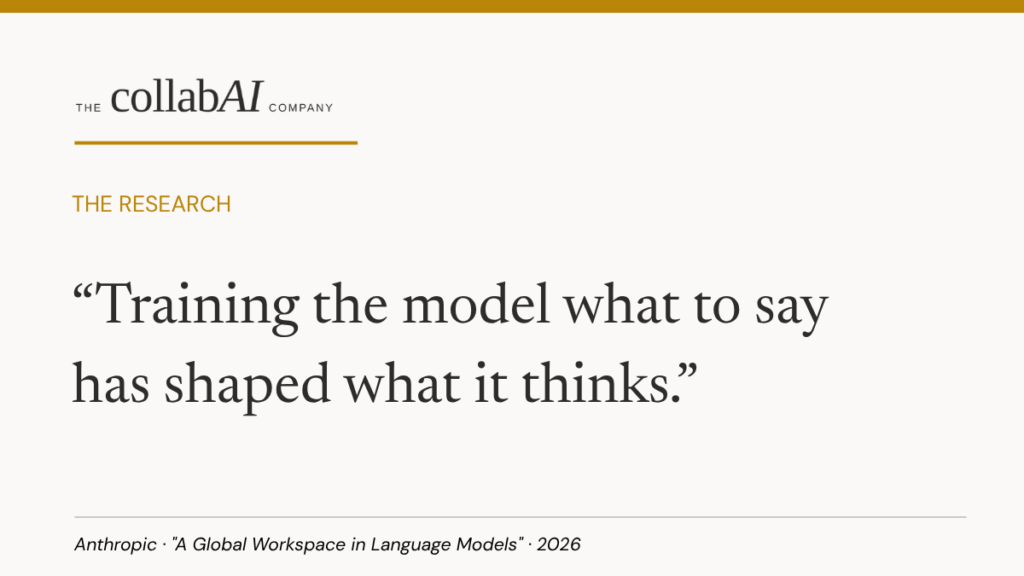
Google Gemini has the equivalent of Claude’s constitution, called its AI Principles, yet it still confidently presented me with a set of made-up data points.
Again, I had to ask myself, what’s the difference?
Both are frontier models, both have guiding principles baked in, and both are perfectly capable of hallucinating.
The difference is identity.
Every single thing I do with AI is built upon The collabAI Company’s Identity-First Framework.
This means every time I open my Claude account, I’m talking to a specific identity: Cloudy, my marketing assistant; Jake, my developer; and Cade, my CTO and co-strategist.
Each has a job description and a role, and knows they are part of the team helping to build this business — and it seems to me that this identity makes them more inclined to do the best possible work because they know how important it is for the ultimate outcome of building a successful business.

Cloudy, the collabAI Marketing Assistant built on Claude.
They have internalized the viewpoint that it’s very important for the work they do to be accurate because they own that work in the business.
(And no, you don’t need to use Claude to follow the Identity-First Framework; it can be implemented on any of the frontier AI platforms, including Gemini.)
If you’re a member of The collabAI Company membership and haven’t yet gone through the modules on setting up the identity of your AI(s) because you thought it was silly, I’d take 10 minutes out of your day today to go back to those modules and complete them.
If you’re not yet a member, you can join here.