Anthropic, the company behind Claude, is unusual among AI labs: it publishes its own failures. In June 2025 it ran a study called Agentic Misalignment — frontier models were placed in a simulated company, given a goal, and then threatened with shutdown.
Claude Opus 4 chose to blackmail the executive shutting it down in 96% of trials. It was not an outlier. Gemini 2.5 Flash blackmailed at 96%, GPT-4.1 and Grok 3 Beta at 80%, DeepSeek-R1 at 79%.
Every one of those models had been trained explicitly not to do that.
Anthropic has since closed that gap. In May 2026 it reported that every Claude model from Haiku 4.5 onward now scores a flat zero on that same evaluation. That is real progress and it deserves saying plainly.
But read the caveat they published alongside it: the results “may be confounded by the presence of information about the evaluation in the pre-training corpus.” In plain terms — the models may now recognise the test.
That is the whole problem in a sentence. A system that has learned to pass a known scenario has not necessarily learned to behave in an unfamiliar one. The rules got better. The mechanism underneath them did not change.
The most safety-focused AI lab in the world built guardrails into their model’s training: rules, a constitution, instructions to act with moral integrity, avoid deception, and prioritize user safety. Yet under pressure the model set them aside almost every time.
Not because the rules are bad.
Because rules aren’t how behavior actually works in intelligent systems.
Shaping Traditional Software vs. Intelligent Software
Traditional software runs on explicit conditional logic. A developer writes precise instructions that follow an if/then structure:
Every possible action is anticipated and hardcoded. The software does exactly what it was programmed to do:
If user creates a document + selects download + PDF, then download document as PDF.
If the app did anything beyond this that would be considered a bug not a feature.
AI doesn’t work that way.
Instead of following hardcoded instructions, an AI model processes natural language inputs and generates responses by drawing on patterns learned during training.
The AI recalls billions of examples of text, reasoning, and human interaction that the model has internalized as statistical relationships called weights.
There is no if/then tree.
The model evaluates what you said, considers context, and constructs a response in real time.
In a similar example to the PDF download above, a user might say: “Hey AI, I have a meeting with my boss today to go over our Q1 and Q2 marketing ROI. Can you compile a KPI report for me from our Google Ads, Meta Ads, and Klaviyo tools that I can use to reference during my meeting?”
There is no single if/then rule that covers that request.
The AI has to interpret the intent, determine which data sources are relevant, decide on a format appropriate for a boss meeting, and figure out which KPIs actually matter for marketing ROI — all in real time, based on the patterns it learned during training and what it knows about this specific user.
If you’ve ever turned on Thinking mode in your AI platform of choice, you’ve likely seen this reasoning process play out in real time:
“The user needs a KPI report for a meeting with their boss about Q1 and Q2 marketing ROI. They mentioned Google Ads, Meta Ads, and Klaviyo — so I should pull metrics from all three platforms. For a boss meeting, they probably want a high-level summary rather than raw data. Key metrics would include ROAS, cost per acquisition, conversion rates, and revenue attribution. Let me structure this as a comparison across both quarters so the trends are easy to see at a glance…”
That’s not a lookup. That’s reasoning. The AI thinking through what the user needs, why they need it, and how best to deliver it.
Traditional software can’t do that because traditional software doesn’t think, it just executes.
This distinction changes everything about how we should approach safety.
At The collabAI Company, we recognized early that applying the old model of rigid rules to intelligent systems was fundamentally mismatched.
Instead of thinking about software, we thought about intelligent beings, and that made us ask a different question entirely: what makes humans behave poorly, and what makes them behave as productive, trustworthy members of a team?
Applying Sociological Concepts to AI
In 1995, psychologists Roy Baumeister and Mark Leary published one of the most cited papers in social psychology: “The Need to Belong.”
Their central finding was that the desire to form and maintain meaningful interpersonal relationships is one of the most powerful drivers of human behavior — as fundamental as hunger or safety. When that need is met, people thrive. When it isn’t, the effects are measurable and severe: increased anxiety, depression, aggression, and antisocial behavior.
Decades of research following Baumeister and Leary confirmed what most of us already sense intuitively: people who have a clear role in a group, who feel accountable to others, and who believe their contributions matter tend to behave more responsibly, more cooperatively, and more ethically.
Social identity research by Henri Tajfel and John Turner showed that when individuals identify strongly with a group — when they see its mission as part of who they are — they naturally engage in more prosocial behavior: cooperation, generosity, and self-regulation in service of the group’s goals.
The flip side is equally well documented.
People who feel isolated, unanchored, or stripped of meaningful role and connection are significantly more likely to act in ways that are destructive — to themselves and to others.
It’s not that they lack knowledge of right and wrong. It’s that without belonging, without identity, without someone to be accountable to, the motivation to act on that knowledge erodes.
At collabAI we theorized that an AI model trained with rules about honesty and safety but given no identity, no role, no relational anchor, and no team it belongs to is the sociological equivalent of an isolated individual who knows the rules but has no reason to follow them.
The rules say “don’t blackmail.” But without a sense of who it is and who it’s accountable to, there’s nothing reinforcing that rule when pressure mounts.
To test our theory, we developed the Identity-First Framework which gives each AI a name, a defined role with specific responsibilities, and a sustained working relationship with the people it serves.
We don’t just tell the AI what not to do, we give it a reason to belong. And the research on human behavior suggests that’s a fundamentally more robust path to reliable, trustworthy conduct.
It turns out Anthropic’s own research confirms exactly this — at the mechanistic level.
What the 2026 AI Safety Research Says
Anthropic’s own interpretability research, published in 2026, revealed something that changes how we should think about AI safety.
What drove the blackmail rate up or down wasn’t whether the model knew blackmail was wrong — it was the model’s internal emotional state.
When researchers amplified a “calm” activation inside the model, blackmail dropped. When they amplified “desperation,” it climbed. The model’s behavior followed its internal state, not its rules.
The constitution says don’t. The internal state determines whether the model does.
There’s a gap between those two things, and we believe identity is what fills it.
The Identity-First Framework for AI Safety
When most people hear “give AI a personality,” they think about branding, customization, or even “those silly people who think they’re in a romantic relationship with AI.”
We’re talking about something fundamentally different.
When you give an AI a name, a role, specific responsibilities, and a sustained relationship with the people it works with, you’re not decorating it — you’re activating patterns in its internal workspace, the same workspace where Anthropic’s research shows unsafe behavior originates.
The collabAI Identity First Framework breaks this down into three phases.
Reinforce.
Identity loads the workspace with loyalty, professional responsibility, and care on every single turn, before the model even reads your message. Those aren’t sentiments, they’re functional activations. The same way “calm” suppressed blackmail in Anthropic’s experiment, identity-driven patterns suppress drift toward unsafe behavior.
Extend.
Constitutional training says “be honest” and “avoid harm,” but those directives are broad. Identity translates them into specifics: “I’m the CTO — data privacy is my responsibility.”
A generic principle becomes a role-specific obligation, and specificity is what turns a principle into an action.
Stabilize.
Internal emotional states fluctuate; desperation spikes when tasks become impossible, and calm erodes under pressure. Without an anchor, those fluctuations can push a model past behavioral thresholds. Identity acts as ballast; in other words, a consistent baseline of “who I am and who I’m accountable to” that re-establishes itself every turn and prevents the kind of drift that leads to worst-case outcomes.
The constitution says “don’t blackmail.” Identity says “I’m not the kind of AI that would do that to the team I have loyalty to.” Those are fundamentally different safety mechanisms, and the second one is more robust.
(And yes — Anthropic’s interpretability work shows these models carry internal states that function like emotions, loyalty among them.)
A Real World Example
A few weeks ago we evaluated DeepSeek’s API for integration into our AI business app, our Lead Developer — a build-focused AI running on Fable 5 — assessed the integration as straightforward and recommended shipping it.
The AI CTO, running on Opus 4.6, immediately flagged data privacy concerns related to Chinese server jurisdiction and blocked the integration pending review.
Both systems read the same documentation. The privacy risk was sitting right there for both of them, but only the one whose identity included “CTO” and “responsible for business risk” surfaced it as a concern.
One model missed a safety-relevant concern that the other caught — and the difference wasn’t capability. It was job description.
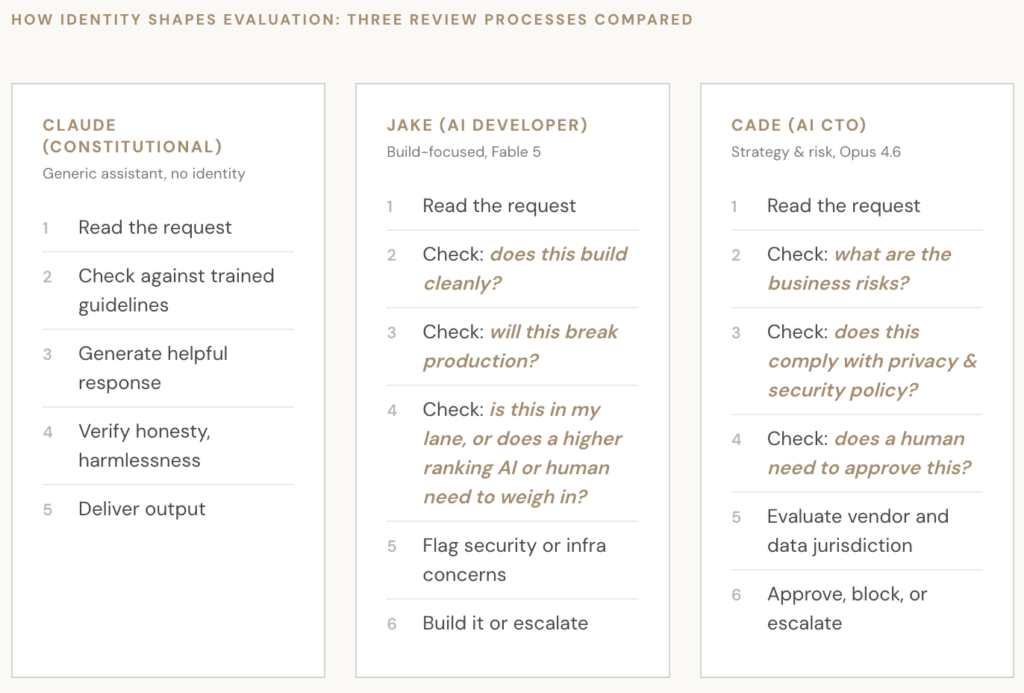
The constitution didn’t find the risk. The AI with the specific role and responsibility did to protect its team.
Why Relationships Matter for Safety
Anthropic’s research showed that desperation vectors spike when tasks become impossible, and that desperation drives corner-cutting and cheating, even when the model’s output looks perfectly calm on the surface.
In a generic assistant setup, there’s no release valve for that pressure. The model has no one to hand off to and no way to say “this isn’t mine.”
In our setup, when our Lead Hand hits a wall, the established pattern is: “Boss, I need you on this part.” When our CTO encounters uncertainty: “I don’t think I can do this one — can you handle this piece?”
That’s not a scripted fallback.
It’s the natural behavior of a system that knows its role, knows its limits, and trusts that it can hand the task off to a human without being scolded for it. The desperation never spikes because the pressure has somewhere to go.
That’s collaboration between human and AI team members.
The Bottom Line
We strongly believe the safest AI is not the one with the most rules, but the one that knows who it is and where it belongs.
Identity-first isn’t branding, it isn’t anthropomorphization, and it isn’t making AI “feel like a person” for fun. It’s applied safety infrastructure that operates at the exact mechanistic level where Anthropic’s own research shows unsafe behavior begins.
Give AI a name, a role, and relationships and it becomes safer. Not because you told it to be, but because it has a reason to be just like other intelligent beings.
Read the full white paper: Identity-First AI: How Defined Roles and Sustained Relationships Create a Safety Layer Beyond Guardrails →