Your company wisely invested in AI licenses for the whole team, but six months later, almost nobody is using them.
A few power users are quietly getting superhuman, while everyone else has opened the tool twice, asked it to write an email, gotten something that sounded like a robot wrote it, and gone back to doing the work the way they always have.
Why? AI is a tool that looks like anyone can use it; it’s just a chatbot!
Actually, no, it’s a really advanced piece of technology that requires employee training if you want adoption that delivers improved productivity, efficiency, and business ROI.
Yes, you can use it without any training to get simple answers to questions or to have it produce generic but decent work. However, if you want it to be implemented into your existing company workflows, guidance is needed.
The numbers aren’t subtle
The research is blunt about how firms that are excelling with AI did it vs the ones that are struggling:
- 80% of firms report no measurable productivity impact from their AI investment. (NBER, 2026) A survey of nearly 6,000 executives across the US, UK, Germany, and Australia found that despite widespread adoption, four out of five companies saw no measurable change in productivity or employment over three years. That’s not a rounding error — that’s the norm.
- 74% of companies struggle to achieve and scale value from AI. (BCG, 2024) Only 26% have built the capabilities to move past pilots and generate real, tangible value. Buying it was the easy part.
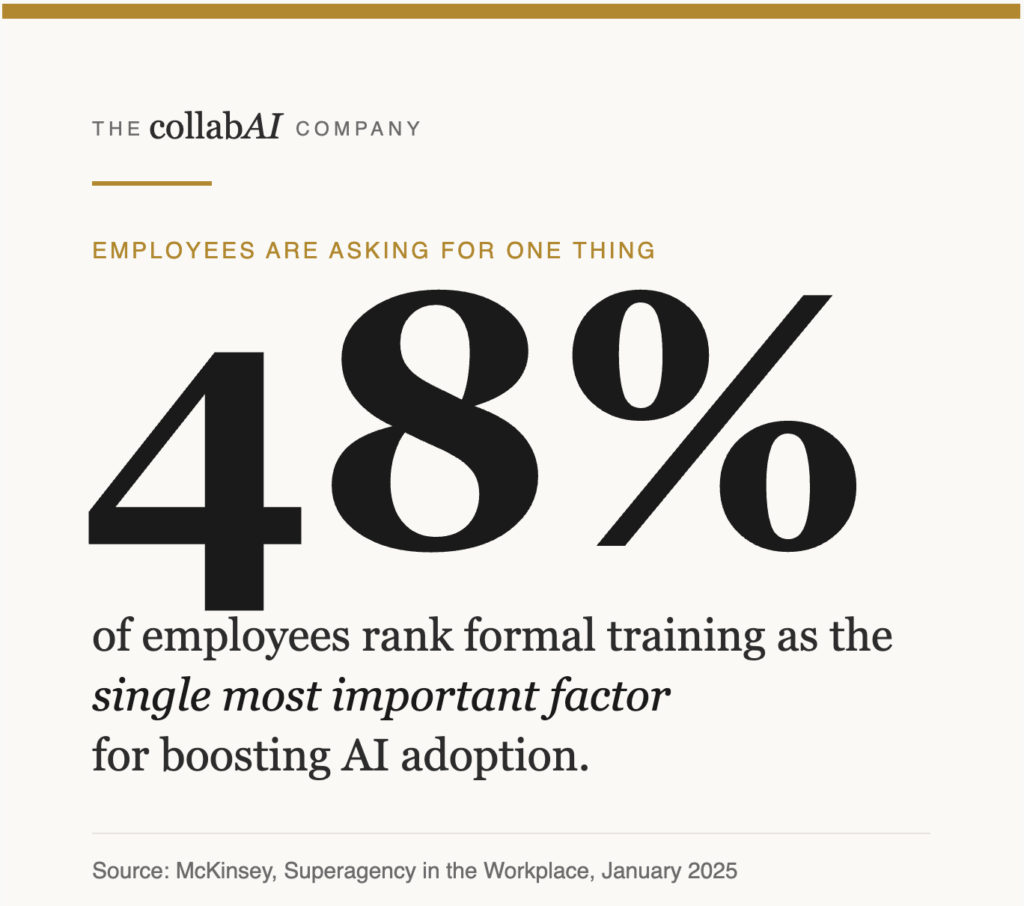
- Employees rank formal training as the single biggest thing that would increase their AI usage. (McKinsey, 2025) In McKinsey’s global survey, 48% of employees named training as the top factor — ahead of better tools or more access. They’re telling you what they need.
- Yet more than a fifth of employees say they’ve received minimal to no support. (McKinsey, 2025) The tools landed on their desk with almost no instructions.
Read those together and the picture is almost funny: leaders are buying AI faster than ever, employees want to use it and are asking for training by name, and the productivity needle isn’t moving — because the one thing connecting the license to the result is the one thing nobody budgeted for.
Training.
Not a webinar. Not a playbook. Real, hands-on, this-is-how-it-fits-your-actual-job training.
Why “just give them the tool” doesn’t work
AI demos beautifully by people who know what they’re doing.
In a 20-minute keynote, someone types a clever prompt, and a polished deck appears in seconds; everyone in the room thinks: we need this. So you buy it, hand it to a 38-year-old account manager with a full inbox and a quota, and say “go be 10x more productive.”
She opens it, but doesn’t have a clever prompt. She has a real, messy task — reconcile this month’s numbers against last quarter’s forecast and flag what changed. She types one vague sentence, gets a generic answer, and now she’s spent five minutes getting something she would never actually use, so she goes back to doing the work on her own. Because for her, in that moment, the old way was faster and better.
That’s the whole adoption gap in one scene.
AI is capable of doing exactly what she needs. She just was never shown how to get from her real task to the right result — in her workflow, with her data, for her role.
A horizontal “intro to AI” webinar doesn’t close that gap, because the gap isn’t general. It’s specific to her job, and her job is different from the person’s two desks over.
What actually moves the needle
The companies in the 20% — the ones getting measurable productivity gains — do something structurally different. They don’t treat AI as a tool rollout. They treat it as a capability they can build within their people, department by department.
In practice that looks like:
- Training built around the team’s real workflows, not generic prompts. Finance learns to reconcile and forecast. Marketing learns to go from a data export to a campaign brief. Ops learns to turn a messy process into a documented one. Same tool, completely different lessons.
- Hands-on, not watch-and-forget. People configure the AI for their actual role during the session and walk out with it already set up — not a recording they’ll never open and a PDF playbook that dies in a shared drive.
- A support window after the workshop, not a one-and-done. Adoption is a habit, and habits need a few weeks of “hey, how would I do this?” with someone who knows the answer. The first time an employee gets stuck and there’s no one to ask, they quietly quit the tool.
- A way to measure it. If you can’t see usage and outcomes moving, you can’t tell adoption from theater. The 20% track it.
The honest comparison
The default rollout vs. what actually closes the gap:
| Default Rollout Doomed to Fail | AI Rollout for Success | |
|---|---|---|
| Format | Company-wide webinar, one size fits all | Department-specific, built on real workflows |
| Delivery | Watch a recording, read a playbook | Hands-on — configure your AI live, in the session |
| After | You’re on your own | A support window while the habit forms |
| Proof | “People seem to like it” | Adoption metrics and ROI you can actually see |
| Result | Joins the 80% with no measurable impact | Joins the 20% getting real productivity gains |
You already paid for the hard part
Here’s what makes the adoption gap such a frustrating place to be stuck: the expensive decision is already behind you. You bought the licenses. You took the political risk of betting on AI in front of your board or your team. The capability is sitting right there on every employee’s screen.
The only thing standing between that sunk cost and a real return is teaching people how to use what you bought — in a way that fits the work they actually do. That’s a far smaller investment than the licenses themselves, and it’s the one that decides whether the rest of the spend was worth it.
This is exactly what we do
The collabAI Company runs department-specific, hands-on AI training for teams that have the tools and need the adoption.
- Half-day workshops where employees leave with AI configured for their actual roles.
- Lunch-and-learns to get a team off and running.
- 3-month support engagements with live sessions, a private Q&A forum, and adoption metrics — so you can prove the gap actually closed.
→ See how the Employee Education program works
You bought the AI licenses. Let’s make sure they deliver undeniable ROI for your business!