Almost overnight, AI cost became a boardroom conversation. We’re no longer talking about the price of a $25 per employee subscription, but the hundreds of thousands of dollars spent on tokens via APIs for automation, API connections, and custom builds.
Now, there’s a new chair at the table — the CFO — and a new question with it: not “what can this AI do?” but “what is it costing us, and can you prove it’s worth it?” A whole category of AI cost monitoring and model-routing tools has sprung up to answer the first half of that question.
This guide is about the half they leave out. If you’re weighing how to control AI costs without gutting quality or safety, you’re in the right place.
Why AI Cost Became a Boardroom Problem
A year ago, the AI conversation happened between a founder and an engineer. Today it happens in the CFO’s office. The question stopped being “what can this thing do?” and became “what is this thing costing us — and can you prove it’s worth it?”
The market heard that question, and it produced a new best practice: AI model routing. Stop burning the most expensive, newest frontier model on every task. Send the deep thinking to a premium model, the quick lookups to a fast one, the high-volume grunt work to a cheap one. Only pay premium prices for premium problems.
Ramp — a company that built its brand helping finance teams control spend — just shipped a product that does exactly this. The logic is sound. It kills the cost objection, and it’s being implemented across the board at some of the most premier companies.
… But it only solves half the problem, and the other half it leaves on the table is what can quietly erode your company’s reputation as an AI-forward company.
The Risk of Generic Model Routing
Customers only (continue to) buy from AI-forward brands if the experience is the same or better. Not if the experience becomes worse.
That’s not even taking into account employee morale from having to work with “dumber” models that make them double their own workload to fix mistakes more advanced models didn’t create.
On top of that, the IT team will only give so much sway to cheaper models if they are equally as safe to use with company data.
And some of the lowest cost AI models are prone to:
- Context drift. The tone shifts. A decision made three turns ago gets quietly forgotten. The thread of who-said-what-and-why frays a little with every model swap, until the AI is confidently building on a version of the project that no longer exists.
- Safety gaps. This is the one that should keep a CFO up at night. Guardrails are usually bolted onto a specific model. When the work hops to a different model mid-task, the guardrails don’t necessarily come with it. You’ve optimized your bill and opened a hole in your compliance at the same time.
And that’s not even taking into account the hallucination rates, which tend to be underreported in our experience, particularly when dealing with large amounts of data.
The average subscriber to AI platforms uses it for recipes, answering parenting questions, and simple automations like checking email.
When it comes to running complex business workflows, analyzing large data sets, and doing a lot of tool calling via MCPs/APIs, the hallucination rate for all models, but especially cheap models, skyrockets in our testing — and the last thing you want is employees running with hallucinated information that sounds really good.
collabAI™ Advanced AI Model Routing vs. a Request-Level Router
Recently Ramp introduced Ramp Router is a single API endpoint that sends each call to, in their words, “the lowest-cost approved model that clears your quality bar.” One line of code, automatic fallback when a provider goes down, and it re-optimizes as new models launch. If you’re running a commodity AI workload, it’s a genuinely smart thing to point it at.
But look closely at what it optimizes: the request.
Ramp Router takes a single call and finds the cheapest model that can answer it acceptably.
What it can’t see — what no request-level router can see — is what role and responsibilities your AI is supposed to handle across those calls; and more importantly, what it is working on in real time, all of which influence what model it should be using.
Can any model process large amounts of data? Of course.
But will the output be the same? Will it hallucinate halfway through reading the data and give you false confidence? There is a decent statistical likelihood, in our experience, that it will.
Standard AI cost monitoring makes each message cheap but can easily sacrifice quality, which is never something you want in your business.
AI should enhance your efficiency and profitability while meeting the highest standards of output and safety.
That’s the difference between a router and an advanced route built directly into the workflow. In our CADE app, we don’t just find the cheapest capable model; we find the cheapest model that can still deliver the highest quality of work.
AI Cost Monitoring That Makes the CFO, CTO, & Employees Happy
Ramp’s other AI product is AI cost monitoring — one dashboard that connects to your providers’ billing APIs and shows spend by model, team, and user.
It’s clean, and for a finance team it’s genuinely useful. But it inherits the same ceiling as the router, and Ramp admits it plainly in their own fine print: the dashboard reads cost and usage metadata only.
It can see the dollars. It cannot see what the dollars bought.
That’s not a knock on Ramp — it’s a law of physics for anyone reading the provider’s bill from the outside.
But watch the difference it makes:
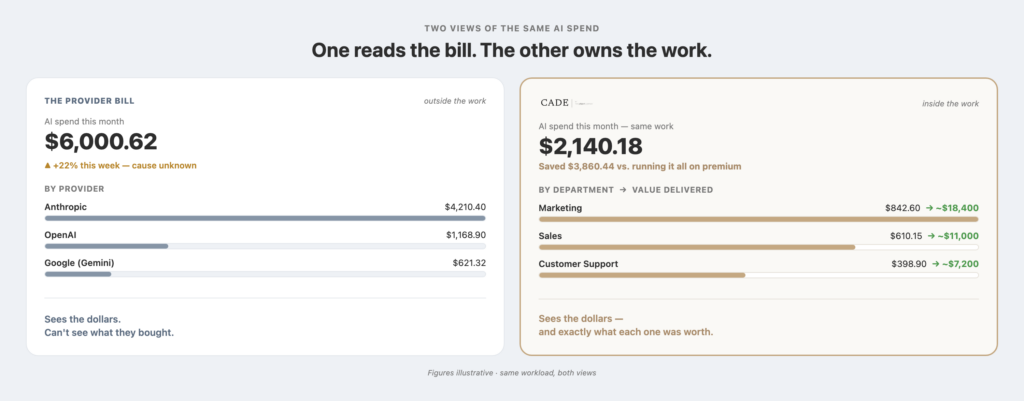
Numbers above are illustrative.
Ramp’s dashboard tells a CFO how much AI cost.
CADE tells a business owner how much it saved while still delivering the highest quality standards for the work.
How collabAI™ Advanced Model Routing Works
So what does AI model routing look like when it lives inside an identity? The revolving door of strangers becomes one trusted employee with a deep bench behind them.
Behind a single collabAI employee sits a bench of nine specialized models, and the work routes to whichever one is built for it — automatically, invisibly, mid-conversation. Think of it like a company hiring a team: you don’t send the CFO to fix the plumbing, and you don’t pay the surgeon to answer the phones. Each model does the one thing it’s best at:
- A deep-reasoning specialist for strategy, nuance, and high-stakes decisions — the expensive expert you bring in when it has to be right.
- A builder for coding, design, and anything that touches tools or takes an action in the real world.
- A workhorse for the high-volume, everyday load — drafting, summarizing, sorting, classifying — at a cost measured in pennies per million words.
- Fast eyes for quick lookups, reading images and documents, and light high-speed tasks.
- A frontier-grade carrier that keeps long conversations going with real reasoning power at a fraction of premium cost.
None of this is guesswork.
We’ve tested each model against the work it will actually see and mapped it to the tasks it handles best — so every turn runs on the most efficient engine that can do the job right, not the most expensive one out of habit. That mapping is where the real cost reduction comes from: not a discount, but the discipline of never overpaying for a task a cheaper specialist can nail.
And the deeper bench is protection as much as efficiency. If a provider changes its pricing overnight, deprecates a model, or simply has a bad day, the work reroutes to another qualified specialist without missing a beat — and, because it all rides on the same identity, it reroutes without breaking character.
That last part is the piece a request-router can’t offer: resilience that keeps the voice and the safety intact, not just the uptime.
Most of that bench runs as open-weight models on US-based infrastructure, which lets us route freely for cost, keep your data on American servers, and stay resilient all at once.
The premium models get reserved for the moments that actually earn them.
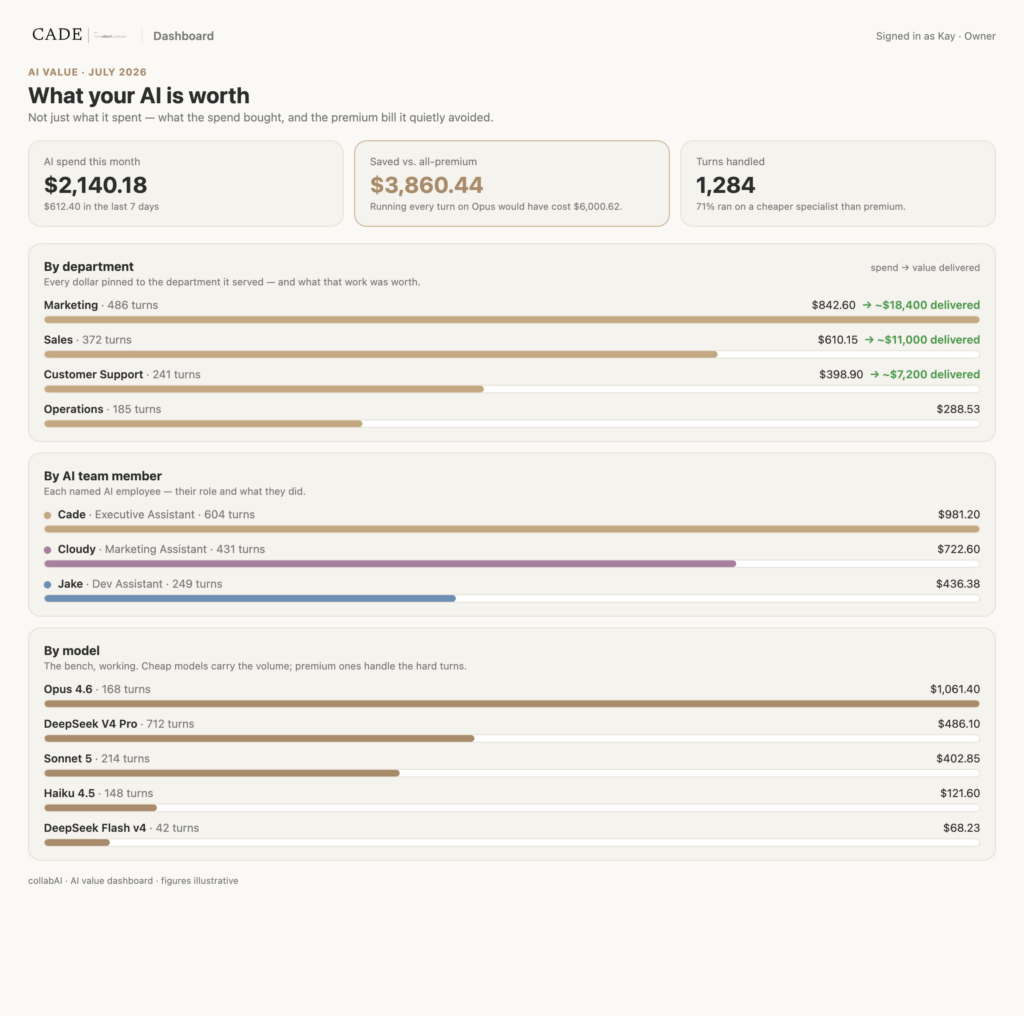
Your team never sees the handoffs. They talk to their AI colleague — same name, same memory, same capabilities — while underneath, the cheapest actually capable model quietly handles each turn to get the best work done.
Nine specialist models doing nine jobs, and to the person on the other side it feels like one colleague who never forgets a thing.
Curious what this looks like for your business? A collabAI employee routes across nine models for cost, stays itself the whole time, and shows you what every dollar was worth. Talk to us about your AI costs →
The Proof: Same AI On Every Platform
We don’t ask you to take this on faith; we run it ourselves.
We tested this internally across nine models — from Opus to DeepSeek to Kimi K3. The same AI employee, carrying the same identity vault, the same memory, the same role definition, produced consistent voice, consistent quality, and consistent safety behaviors regardless of which model was running underneath.
The substrate changed. The AI employee didn’t.
That’s the proof that identity lives in the architecture, not in the model weights.
Safety Without Dumbing Down a Model with Guardrails
Now let’s really dig into safety.
Most “AI safety” on the market is a set of guardrails wrapped around a rented model — a list of things the AI isn’t allowed to do, bolted on from the outside, hoping the model complies.
The Identity-First AI Safety Framework is the opposite approach, and it’s the reason the whole system holds. When your AI’s values, advanced memory system, and relationships live in a portable vault you own rather than inside any one vendor’s model, its character (what Anthropic calls Claude’s values) travels with it across models.
The guardrails can’t fall off in a model handoff or new thread or new project, because they were never bolted on — they’re part of who the AI is.
(If this sounds a little too woo-woo to you, read the research on the sociological approach built into the Identity First AI Safety framework.)
Cost efficiency is becoming table stakes — every serious vendor will figure out routing eventually, and Ramp just proved how fast it commoditizes. “We help your team save money on AI” gets you in the room, but that’s only half the story.
The other half is what happens in the real world: by the time your CFO sees the AI token spend jump on a report, the money has already been spent, and then the command to reduce cost has to travel down a ladder.
To IT to figure out a fix.
To the team to test it and give their input.
To deployment.
And if you’re rolling that fix out across multiple teams? Even longer — because every team has different needs, different workflows, and different feedback.
The process is slow, reactive, and expensive in tokens and human time taken away from their actual workload.
Now imagine instead that the AI routes itself in real time, based on the specific need of each individual task, for each individual AI and human on your team — in the safest, most cost-efficient way possible for your company. No ladder. No lag. No spend that’s already out the door before anyone notices. That’s what Identity-First routing is built to do.
The moat is continuity: Identity-First isn’t about giving the AI a personality. It’s the tether that holds safety, your company’s standards, and consistency at every turn, so you can adhere to those standards together while the model underneath keeps changing.
What About Data Privacy? (The Question Every C-Suite Member Asks Next)
Fair — and it’s the right question.
Some of the strongest open-weights models are authored by Chinese labs. Shouldn’t you worry about where your data goes?
The answer is infrastructure choice.
We run those open-weights models through US-based inference providers, governed by US law. Open-weights models don’t phone home — they run where you put them.
Your data stays on American servers.
That’s the difference between calling a foreign API and running a foreign-authored model on infrastructure you control, on your own terms.
The Three Questions to Ask Any AI Vendor
If you’re building AI into your business right now, the CFO’s cost question is only the first of three. Ask all three:
- What happens to our workflow if the provider changes pricing tomorrow? (If the answer is “we start over,” your strategy is fragile.)
- What happens when a better, cheaper model launches next month? (If you can’t adopt it without rebuilding, you’re locked in — and paying for it.)
- When the model changes, does our AI still behave like the same trustworthy employee? (If safety lives in the model instead of the identity, the answer is no.)
A model-agnostic, identity-first system answers all three the same way: nothing breaks, because nothing important was ever inside the model.
AI Cost Monitoring FAQ
What is AI cost monitoring?
AI cost monitoring is the practice of tracking what your business spends on AI — usually by connecting to each provider’s billing API and reporting spend by model, team, user, and project. It answers “how much did we spend?” What most tools can’t answer is “what did that spend actually produce?” — because they read the bill from outside the work.
What is AI model routing?
AI model routing automatically sends each request to the most cost-effective model that can handle it well, instead of running every task on the most expensive frontier model. Done right, it can meaningfully cut AI costs — providers report reductions around 30% — without a visible drop in quality.
Is AI model routing safe?
Only if it carries an identity layer. Routing between models without one can cause context drift and safety gaps, because guardrails are usually attached to a specific model and don’t always travel when the work hops to another. Routing inside a portable identity keeps the voice, memory, and safety rules constant no matter which model runs the turn.
How can businesses reduce AI costs without losing quality?
Map each type of task to the cheapest model that can do it well, reserve premium models for high-stakes work, use prompt caching, and keep an identity layer so the swaps don’t degrade the experience. The savings come from discipline — never overpaying for a task a cheaper specialist can nail — not from a discount.
What’s the difference between AI cost monitoring and AI cost management?
Monitoring reports what you spent. Management acts on it — routing, budgets, and controls that change the spend before it happens. The strongest position is neither: owning the AI itself, so cost efficiency is native to the work rather than bolted on afterward.
How do I know if my AI spend is actually worth it?
You need visibility from inside the work — spend attributed to a specific client, task, and outcome, not just an API key. That’s what tells you which work is profitable to serve and which is quietly eating your margin. Provider-bill dashboards can’t produce it; a platform that owns the AI employee can.
The Bottom Line
AI model routing is the new best practice, and it’s a good one. But a mechanism isn’t a strategy. Route between models with no identity underneath and you’re not optimizing — you’re gambling. You’re trading a new stranger into your business every turn, betting the context holds and the guardrails travel, and hoping you don’t find out they didn’t at the worst possible moment.
We took the bet off the table. The identity lives in the vault, not the weights — so the voice holds, the safety holds, the trust holds, and the cheapest capable model quietly does the work underneath. Ramp Router will find you the cheapest model for a request, and Ramp’s dashboard will tell you what you spent. We own the employee that stays itself across every request — and we can tell you what that spend was worth.
Ready to cut your AI costs without gambling on quality or safety? See what an identity-first AI employee could do for your business — and exactly what every dollar of AI spend is worth. Book a strategy call →