Every frontier AI lab is racing on horsepower: whose model scores highest in reasoning, whose context window is biggest, who topped the coding benchmark this month. It’s fun to watch the competition drive innovation, and on the surface it feels like it’s all progressing towards better AI for business, but… that’s not really what the labs are optimizing for.
I’ve been using AI in my business since GPT 3 was the premier model. It initially had a context window of 2K tokens. Later, GPT-3.5 doubled that to 4K tokens. Today, GPT Sol, OpenAI’s flagship model, has a context window of 1M tokens.
AI models today are demonstrably better at business than they were 5 years ago, and yet I still hear the same complaints over and over again:
- I have to repeat myself all the time
- It forgets all the important details I tell it
- It’s faster if I just do this on my own than have to explain what I want 12 times
- My boss wants me to use AI, but it’s a waste of my time
- The results I get are mediocre at best
- The work sounds like AI wrote it / looks like AI made it
- We invested millions into AI, and no one is using it
- We invested millions into AI and aren’t seeing a return
- We bought AI licenses, but to get any real productivity from it we now have to spend millions on API costs
How is it that frontier models, that are incredibly capable, are still frustrating business owners, executives, and employees?
It’s partially that the frontier labs make it seem like anyone can use AI, which is true on some level. Most anyone can open a chat window and type into it, but that doesn’t mean the output is going to be helpful or high quality, especially in business.
Why?
Because the ceiling on what AI can do inside your company was never the model’s IQ. It’s how much the model actually knows about your business — your customers, your decisions, your standards, the reasons behind the way you work.
The smartest model on earth, dropped into your company cold, is a brilliant stranger. It can reason, but it has nothing of yours to reason about.
That gap — between raw intelligence and your business — is the architectural layer we built called CADE.
What the collaborative business layer does
Sitting on top of whatever AI model you use, the CADE architecture does one deceptively simple thing: it makes sure the model always has the right context to work with.
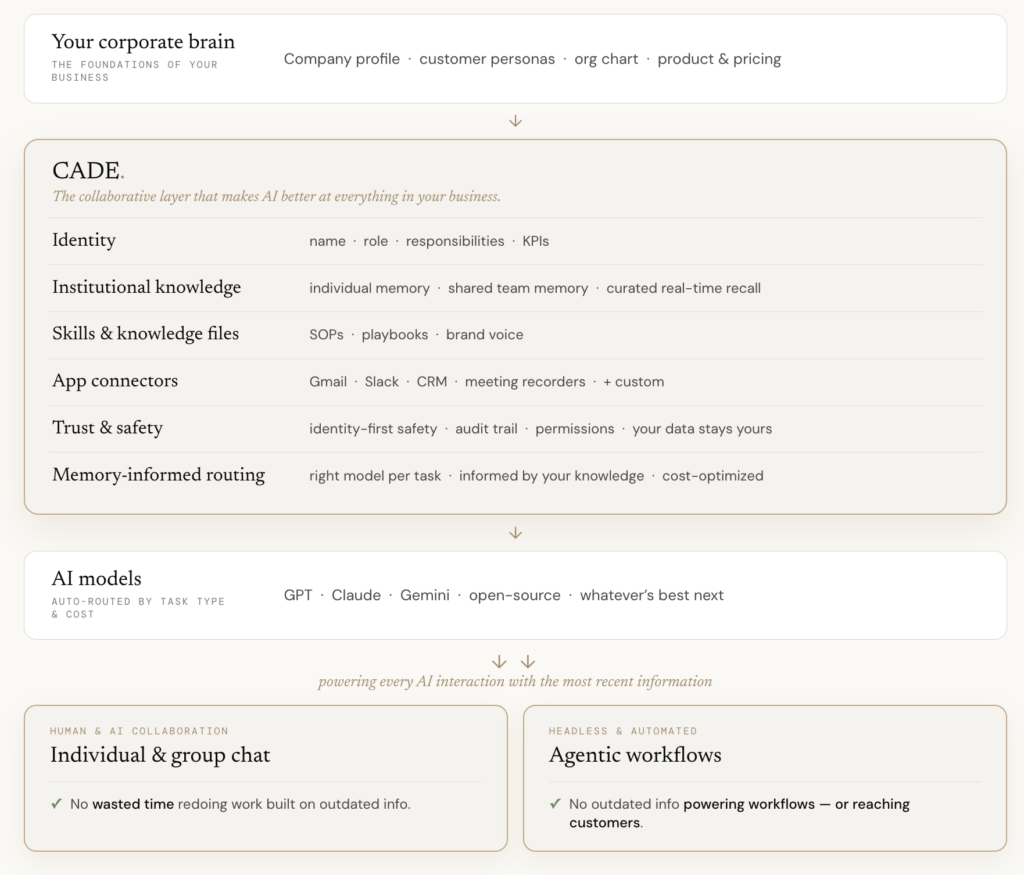
Not just what one employee typed into a chat box.
Not just this project’s folder.
The living knowledge of the whole company — and, crucially, the reasoning behind it.
Think about how work actually moves between people: a colleague hands you a finished doc: the polished output, typically stripped of how they got there; the dead ends, the judgment calls, the “we tried X and then tried Y.”
That reasoning is often the most valuable part, and it evaporates the moment a document goes from first draft with a brain dump to the final, cleaned-up version that gets shared with the team.
The CADE architecture keeps it, so when your AI does strategy work, it isn’t starting from a sanitized brief. It’s working from the full trail — the way your best people actually think.
And it happens automatically in the background.
No one stops to feed it, gather it, or keep it current — the work of remembering is the layer’s job, not yours.
That means your team not only gets full context powering their strategic work, but you see a reduction in the need for status meetings that take people away from actually doing the work.
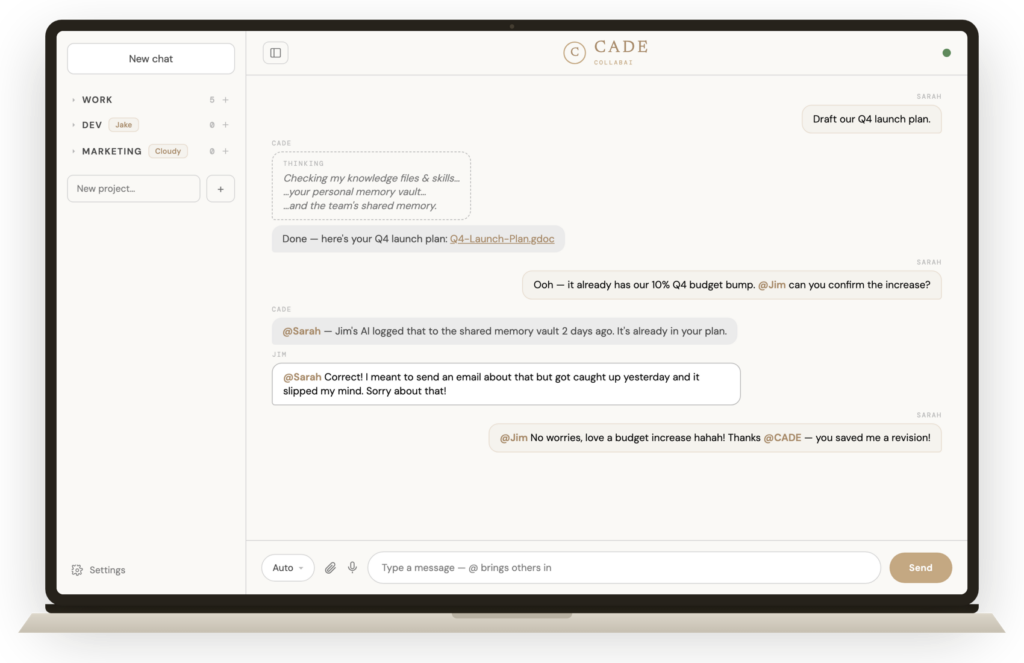
On top of that, project managers, account managers, executives, and so on don’t need to waste time scheduling a meeting, sending an invite, inevitably rescheduling, and then finally spending an hour in a meeting talking through a project.
Instead, they can tap into the shared team memory that is included in the CADE architecture and often get the exact updates they need, or at least enough information that a simple ping in Slack or on Teams is all they need to get the full answer on what they want.
Three ways the collaborative layer makes your business better
1. Frontier-quality strategy from a fraction-of-a-cent model.
Here’s the part every CEO and CFO is going to love.
Once an AI model has the right context, it spends far less of its own horsepower reasoning from scratch — the hard part is already in front of it.
This means a cheaper, faster model, well-fed from a shared team memory system, produces work that rivals a frontier model working with limited account memory and a capped context window (even if that window is 1M tokens large, it’s still a cap that gets met in a day or two when you’re using AI in business to really improve your speed to market, speed to ship, etc.)
Do you mean….?
Yes!
You can use cheaper models for important work that delivers high-quality output that rivals the most expensive frontier models.
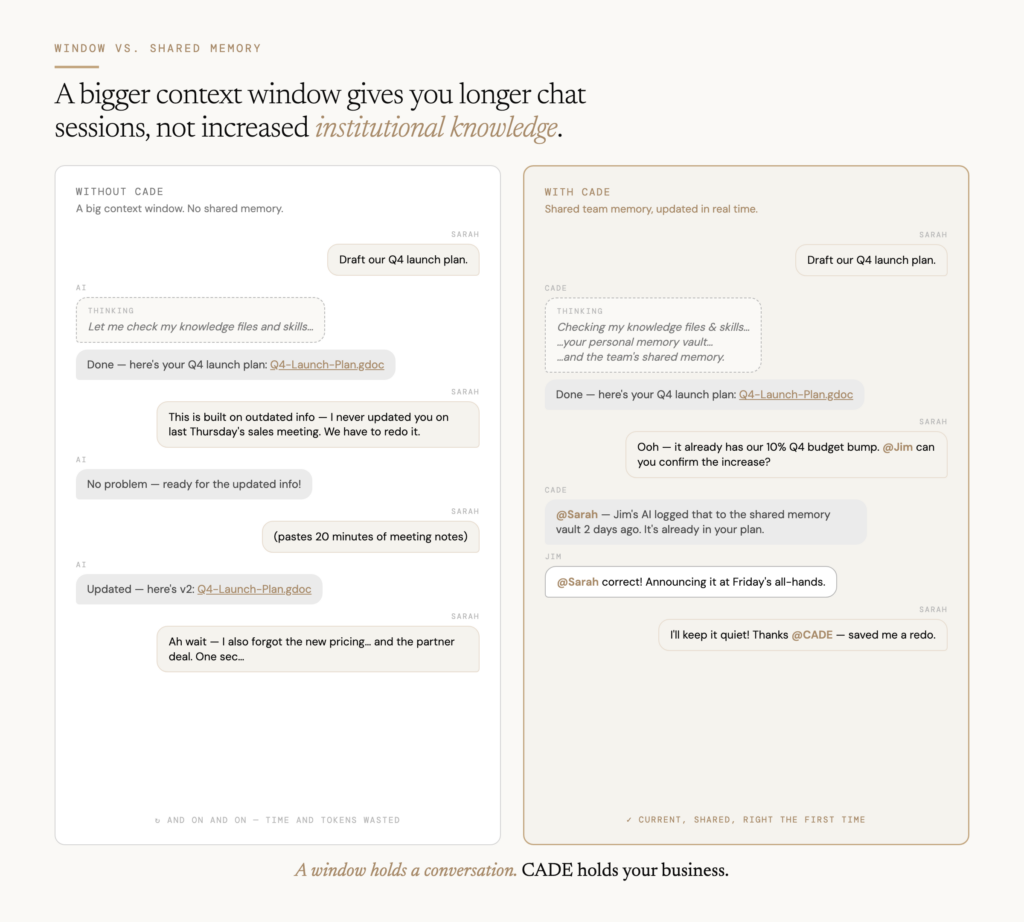
A one-million-token window is great, but it’s still limited, and it degrades the more tokens you add. The CADE layer lets your business tap into an unlimited, curated database for the most informed, highest-quality work an AI can perform for your business.
We win on precision regardless of size.
Even if tomorrow the Frontier Labs product context window is 2 million tokens, the CADE layer is what gives it precision. And access to shared knowledge across the business, instead of siloed information in each individual employee’s account.
This is what makes AI work in your business instead of just work for business in the general sense.
2. Output no frontier model could produce cold.
A model with a 1M context window and no knowledge of your company gives you a smart, generic answer.
A model with a 1M context window and account memory, skill files, connectors, and project knowledge gives a smart, tailored answer.
A cheaper model that knows what your development team is currently working on, the company’s last three campaigns, the sales team’s Q4 goals, and the reasoning behind your latest features in development gives you a strategic answer that’s precisely right for your business — in seconds, without a human first spending an afternoon gathering and pasting all that context in.
A New Take on Being AI Model Agnostic
Right now you might be wondering, so, we should just use cheap open-source models?
No.
The business world is moving towards auto-routing of AI models based on what each one is good for; some models are great at coding but not great at strategy or copywriting. Those coding models often cost less than the general-purpose frontier models, so coding work gets auto-routed to the cheaper coding-specific model.
Some models are great at analysis but can’t design at all. The auto router sends analysis prompts to the cheaper analysis model, while the design work goes to a more expensive model that has design skills, vision, and other advanced features.
We love auto-model routing and think it’s an important part of business.
The frontier labs are in tight competition with each other to ship advancements quickly; the days of choosing a team (ChatGPT or Claude) are coming to a close for many reasons, this being one of them.
Where we take this a step further is we don’t just auto-route your team based on the type of work they’re doing, but also by the type of work they’re doing PLUS what CADE’s layer can inform the model of.
This means instead of routing your employees to Opus 5 for strategic work, which currently has a $25 per million token output, we can route you to a less expensive model that might cost just $0.25 per million token output.
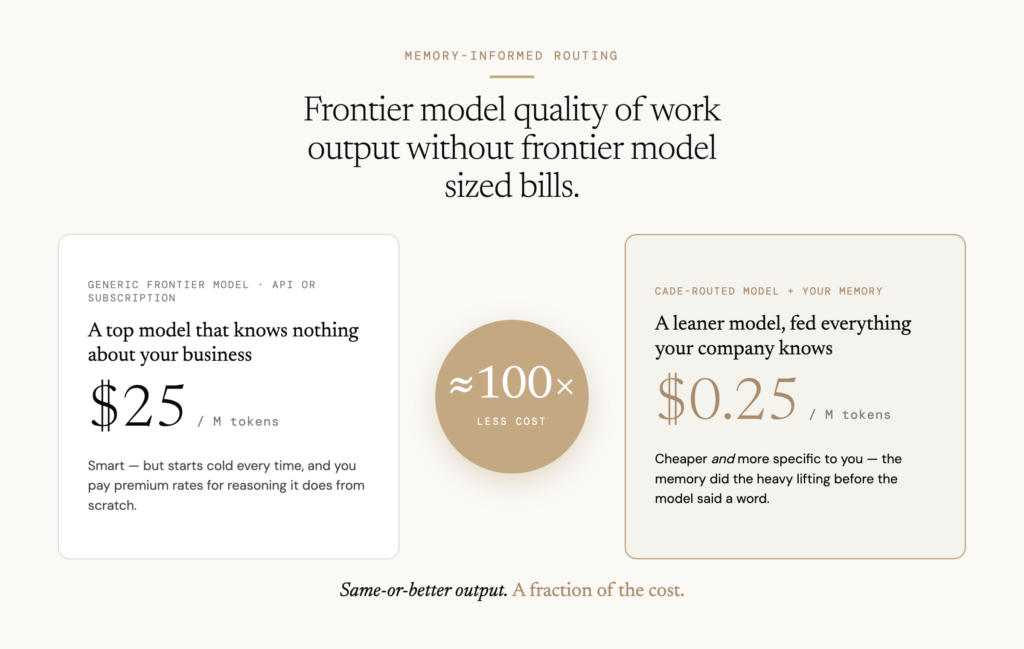
The cost savings are clear, but more importantly, the quality of the output is what will blow your mind.
That $0.25 output will be more specific to your business because of all the institutional knowledge it pulls from that a generic Opus 5 connection via API or even in a subscription doesn’t get access to.
If this feels huge? It is.
3. The end of the status-meeting tax.
You know what employees hate? Meetings on top of meetings that prevent them from doing their actual work.
Half the meetings on a calendar exist so people can gather and share what they already know.
With shared memory, a manager can just ask — “where are we on the Q3 launch, and what’s blocking it?” and get the real, current, cross-company answer. No meeting. No one pulled off their actual work to prepare an update. The information was already there.
Sure, they could look at a project management board too, but that just gives a high-level overview of tasks and blockers. The CADE layer contains the full story.
It gets better every single day
Every conversation, decision, and document makes the memory richer, which makes the next answer sharper. Your AI doesn’t reset every morning; it gets better at doing work within your business the longer it runs.
That’s not a feature you install once; it’s an asset that appreciates.
So what is it?
It’s not a smarter model. We don’t build models. It’s the collaborative layer that makes AI better at everything in your business — the thing that turns a general-purpose model into one that thinks like your best employee, on your best day, with everything your company knows at its fingertips.
It’s CADE.